Łukasz:
Electricity Prices in Cyprus 2026 - EAC Bills and Air Con
Konstantina has a method for the heat that I think every Cypriot knows: cool the room, switch the air con off, complain about the heat, switch it back on, and round we go. For a long time I believed it saved electricity. Every time it’s switched on, the air conditioner starts at full power to bring the temperature down again, so the seesaw achieves very little. Instead of arguing about it, I sat down with an EAC bill and started checking what exactly I was paying for. From a distance electricity prices in Cyprus look like a single rate per kWh, but the bill has six separate items, not counting the fixed charges. One of them jumps every billing period, and that’s why the same kilowatt-hour cost about 27 cents in May and about 33 by autumn.
💡 How much does 1 kWh of electricity cost in Cyprus in 2026?
Almost every household buys electricity from the EAC (Electricity Authority of Cyprus) on domestic tariff 01, a single rate around the clock. Since 1 May 2026 a new tariff approved by the regulator CERA has applied (what counts is the meter reading date on the bill). I copied the rates from the official EAC tariff sheet, and the fuel adjustment from the table on the EAC website. This is what a kilowatt-hour looks like on tariff 01:
| Price component | May 2026 | September-October 2026 |
|---|---|---|
| Energy charge | 17.89 cents | 17.89 cents |
| Fuel adjustment | 2.38 cents | 8.02 cents |
| Network charge | 3.93 cents | 3.93 cents |
| 9% VAT on the above | 2.18 cents | 2.69 cents |
| RES and energy saving fund levy | 0.50 cents | 0.50 cents |
| PSO charge (public service obligations) | 0.05 cents | 0.05 cents |
| Total | about 26.9 cents | about 33.1 cents |
On top of that, every two months there are fixed charges: 8 euros supply charge and 0.94 euros for meter data management. With VAT that’s just under 10 euros on every bill.
In the second half of 2025, according to Eurostat, Cyprus was above the EU average, but it recorded the biggest drop in household electricity prices in the whole EU, 14.7% year on year. On the autumn 2026 bills you can no longer feel that drop. The rate is back at around 33 cents.
⛽ EAC fuel adjustment in 2026, month by month
The EAC still generates most of its electricity from imported fuel. Every month it calculates the average price it paid, and if that’s above the base price in the tariff (currently 600 euros per tonne), the difference lands on your bill as the fuel adjustment. Customers billed every two months, which means all households, pay the rate for the two-month period.
| Period (bimonthly customers) | Average fuel price | Fuel adjustment | Full gross kWh, tariff 01 |
|---|---|---|---|
| April-May | €701.74/t | 2.38 cents | about 26.9 cents |
| May-June | €751.90/t | 3.61 cents | about 28.3 cents |
| June-July | €818.65/t | 5.25 cents | about 30.1 cents |
| July-August | €795.83/t | 4.85 cents | about 29.6 cents |
| August-September | €868.63/t | 6.76 cents | about 31.7 cents |
| September-October | €915.50/t | 8.02 cents | about 33.1 cents |
When you compare old bills with new ones, it’s easy to get confused. From January to April 2026 the fuel adjustment was 7.4-9.9 cents, and in May it dropped to under 2.4 cents. Electricity didn’t suddenly get several cents cheaper. CERA simply raised the base fuel price in the tariff from 300 to 600 euros per tonne, so a bigger part of the fuel cost now sits in the energy charge, which went up to 17.89 cents. Overall it comes out about the same.
8.02 cents - that’s the fuel adjustment added for September-October 2026, more than three times as much as in May. You can check the current value on the EAC website under Fuel Price Adjustment.
🧾 The EAC electricity bill, item by item
The first thing that surprises Poles: the bill comes every two months. The EAC reads the meter on a two-month cycle, and if there’s no reading it issues an estimated bill. So the amounts are “double”, and a summer bill for July and August can be a shock if in your head you’re treating it as one month.
The bill also shows a tariff code. In practice three matter:
- 01 - a single rate around the clock, the standard in most homes
- 02 - a two-rate tariff, cheaper at night from 23:00 to 9:00
- 08 - a special tariff for vulnerable customers, with its own tiered pricing
In 2026 tariff 02 gives you practically nothing. Daytime energy costs 17.94 cents, night-time 17.86 cents, and the network charge is the same in both. The difference is 0.08 cents per kilowatt-hour, so on 1000 kWh of night-time use you’d save less than a euro. You can only go back to tariff 01 after six billing periods, so after a year. I’m writing this with Poles used to the G12 tariff in mind, because the first reflex is “I’ll switch to night rate and do the washing after 23:00”. Here you won’t gain anything by it.
Check tariff 08 if you fall into one of the categories on the EAC list. These include large families receiving child benefit for three or more children, single-parent families on the single-parent allowance, pensioners receiving the low-pension supplement, recipients of the guaranteed minimum income (GMI) and people with certain illnesses. Important for Poles: the tariff is also available to citizens of other EU countries legally living in Cyprus. You apply at the EAC.
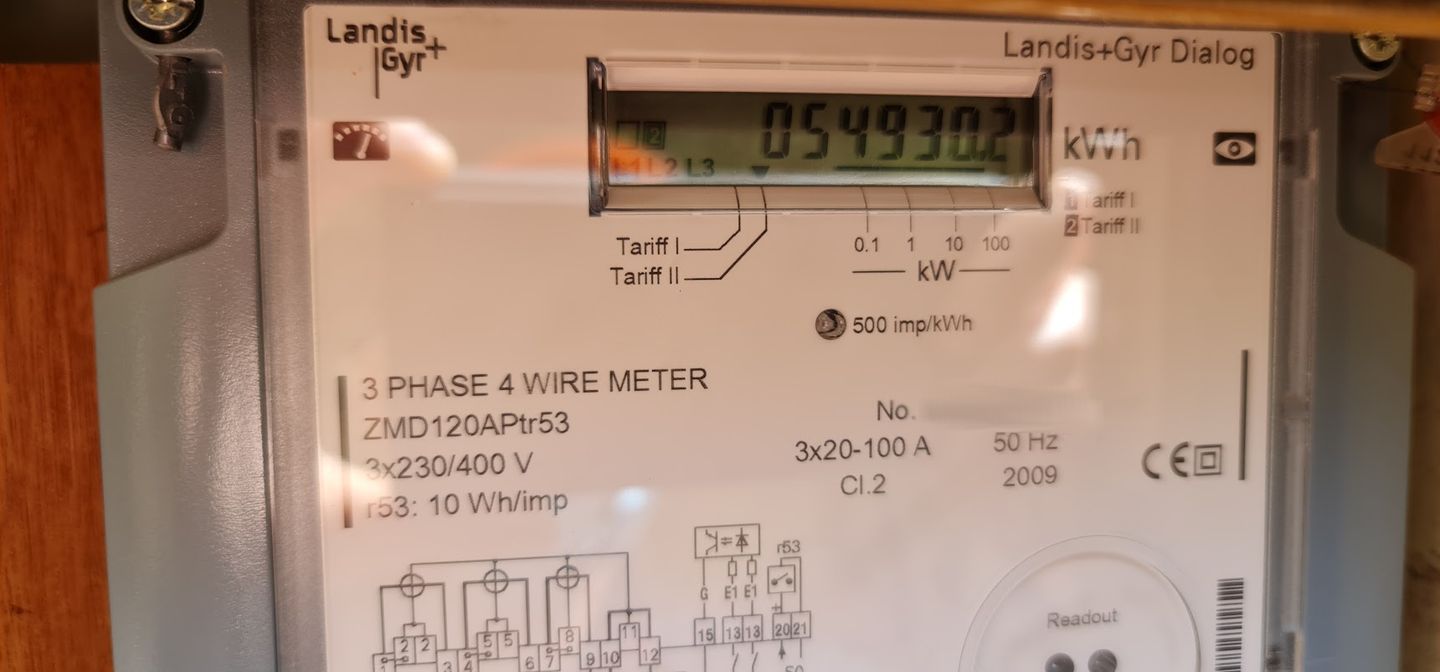
When you transfer the meter into your name, the EAC takes a deposit. A tenant pays it when signing the contract, while for an owner it’s added to the first bill. The change of account holder itself costs 15 euros plus VAT. The EAC usually asks for an ID card or passport, a rental contract or proof of ownership, and a meter reading. You can sign the contract through the portal or by email, without visiting an office. The deposit amount depends on the type of customer, so ask about it when you apply, and take a photo of the meter on moving day so the previous tenant’s consumption doesn’t end up on your bill.
You can pay the bill in the EAC app, on the portal, by card on your bank’s website or at the post office. The most convenient is a SEPA direct debit, which you can set up as soon as you open an account with a Cypriot bank.
🇵🇱 Electricity prices in Cyprus vs Poland - where is it more expensive?
After prices were unfrozen in Poland from January 2026, a kilowatt-hour on the G11 tariff, including distribution and VAT, costs roughly 1.05-1.15 zł gross, depending on the operator and consumption. At about 4.25 zł to the euro that’s 25-27 cents. So in May Cyprus and Poland were paying practically the same. I didn’t believe it myself when I worked it out.
In autumn the picture is different. With an 8-cent fuel adjustment a Cypriot kilowatt-hour costs about 33 cents, some 6-8 cents more than in Poland. That’s the biggest difference between the two countries: in Poland the tariff price is fixed for the whole year, while in Cyprus it depends on how much the EAC paid for fuel.
There’s also a second reason electricity in Cyprus feels expensive, and in my opinion it matters more. In Cyprus you use a lot more electricity. In Poland a house is heated by gas, coal or a heat pump, and in summer hardly anyone cools three rooms for four months. In Cyprus electricity does almost everything: it cools in summer, heats in winter (air conditioning with a heating mode is standard here), often heats the water, and if the house has a pool, the pump runs too. Even at a similar rate, you use several times more kilowatt-hours.
❄️ How much electricity does air conditioning use in summer, and what does it cost?
Air conditioning is the biggest item on every summer bill. A typical 12,000 BTU wall-mounted inverter unit (about 3.5 kW of cooling capacity) draws roughly 1 kW at full power. Once the room is cool it slows down, so over an hour it averages less. For estimates I assume 0.8 kWh per hour.
| Scenario | Daily use | Daily cost | Cost per bill (60 days) |
|---|---|---|---|
| 1 air conditioner, 8 h a day | about 6.4 kWh | about €2.10 | about €125 |
| 2 air conditioners, 8 h a day | about 12.8 kWh | about €4.25 | about €255 |
| 3 air conditioners, 10 h a day | about 24 kWh | about €7.95 | about €475 |
These are rough figures at the September-October rate of about 33 cents. At the July-August rate (about 29.6 cents) it comes out roughly 10% cheaper. An old non-inverter unit set to 18°C in a south-facing room will use a good deal more. A new, correctly sized one in a shaded room will use less.
In an uninsulated house the air conditioner fights the heated walls and roof all day. That’s why we were so strict about insulation and shading when building, and I wrote separately about how the Cypriot climate affects construction.
🌡️ What is the electricity bill in Cyprus in summer and winter?
I worked out a few typical bills on tariff 01, including fixed charges. These are amounts for two months, in two versions: with the May fuel adjustment and with the autumn one.
| Consumption over 2 months | Example | Bill (May, about 27 c) | Bill (Sep-Oct, about 33 c) |
|---|---|---|---|
| 400 kWh | small flat in spring or autumn | about €120 | about €140 |
| 600 kWh | flat in winter, air con heating in the evenings | about €170 | about €210 |
| 1000 kWh | 3-bedroom house in winter or a flat in summer | about €280 | about €340 |
| 1600 kWh | house in summer, air con in several rooms | about €440 | about €540 |
In our experience two periods are the most expensive. The first is July-August, when the air con runs every day. The second is January-February, because in winter a Cypriot house can get colder than you’d expect, and heating with air conditioning costs money too. The cheapest are April-May and October-November, when you often switch on neither cooling nor heating.
Before signing a rental, ask the landlord for copies of last year’s EAC bills for July-August and January-February. Those two bills will tell you more about running costs than any reassurances.
🏠 How Cypriots keep their electricity bill down at home
I picked up most of these habits from Konstantina’s family. They’re simple and cost zero euros.
At their place the air con doesn’t run from morning to night. Cypriots cool the room during the hottest hours and then raise the temperature by a few degrees or switch to dry mode, instead of turning the unit off every half hour. At night they set a timer. Add a fan, ceiling or standing. A fan spreads the cool air, so the air conditioner reaches the temperature faster and runs at full power less often.
The second habit is shutters closed during the day and windows open at night, with mosquito screens, otherwise the mosquitoes will eat you alive. In a well-insulated house this really works. In an old uninsulated building you’ll feel like you’re in an oven from June to September regardless.
The rest are small things that add up:
- washing early in the morning or after sunset, and in summer you don’t need a tumble dryer
- the dishwasher only when full
- no oven in summer, more salads, fruit and barbecue outside instead
- the immersion heater switched off from spring to autumn, because the sun heats the water
- a dehumidifier in damp rooms instead of harder cooling
I didn’t believe in the dehumidifier for a long time. With Cypriot humidity, 26°C can feel worse than 30°C in dry air. Once you pull the moisture out, the room feels cooler and you don’t have to push the temperature down on the air conditioner. Which dehumidifier to choose and how much electricity it uses, I checked while fighting damp in our home in Cyprus.
☀️ Solar panels in Cyprus: net metering, net billing and other suppliers
Together with the pool pump we use about 6 MWh of electricity a year, so without panels, at the autumn rate of 33 cents, we’d be paying close to 2000 euros a year. What changed our bills was solar. Today we usually pay a few dozen euros every two months, and the full figures with production month by month are in the breakdown of how much we save with solar panels. But we owe those results to the old net metering scheme. Every kilowatt-hour we export to the grid is offset against what we draw, as if the grid were free storage. Our contract stays in that scheme until it expires.
Anyone installing panels today won’t repeat those results one to one. Since 1 January 2026 new home installations only get net billing:
- electricity drawn from the grid is bought at the full price on the bill, including the fuel adjustment and VAT
- the EAC buys the surplus you export at a lower rate than retail and settles it in euros
- it pays most to use the electricity as it’s produced, during the day when the panels are generating, or to add a battery
I couldn’t find an official export rate for net billing either from CERA or in the EAC tariff, so before buying panels ask the installer to calculate the payback with figures for your roof and your consumption. You can run a first estimate yourself in the Sun Meter CY calculator, which works out the payback for a specific building using current EAC net billing tariffs. Panels still pay off, they just take longer to do it. The government has been announcing a new subsidy scheme for home batteries for months, and since 16 October 2026 home solar installations have reduced 9% VAT.
Since 1 October 2025 the electricity market in Cyprus has been formally open and you can change supplier. The grid, meters and faults are still handled by the EAC. Independent suppliers are so far aiming mainly at businesses, and I haven’t seen a clearly cheaper offer for an ordinary home. Cyta is preparing to enter the electricity market and talks about bundles with internet at a later stage, so that may change. When comparing offers, look at the price per kWh together with the fixed charges and whether the supplier adds the fuel adjustment.
The most noticeable help from the state is the reduced VAT on electricity, cut from 19% to 9%, extended until 31 March 2027. On a 1000 kWh bill at autumn rates that’s about 30 euros less.