Łukasz:
Plugs in Cyprus - Type G, 230 V and Which Adapter to Buy
On my first evening after the move I took my laptop charger out of my backpack, looked around the room and realised I had nowhere to plug it in. Sockets in Cyprus have three rectangular holes, and my Polish plug had two round pins. Konstantina had of course warned me about British plugs, but I’d packed the adapters in a parcel that was still travelling with Poczta Polska for a few more days. The corner shop saved me: for a bit of change I bought a white adapter. It worked, but it fell out of the wall every time the cable moved. Ten years and one house build later, I’ve written down everything I didn’t know that evening about plugs in Cyprus.
🔌 Sockets in Cyprus are type G, the British BS 1363 standard
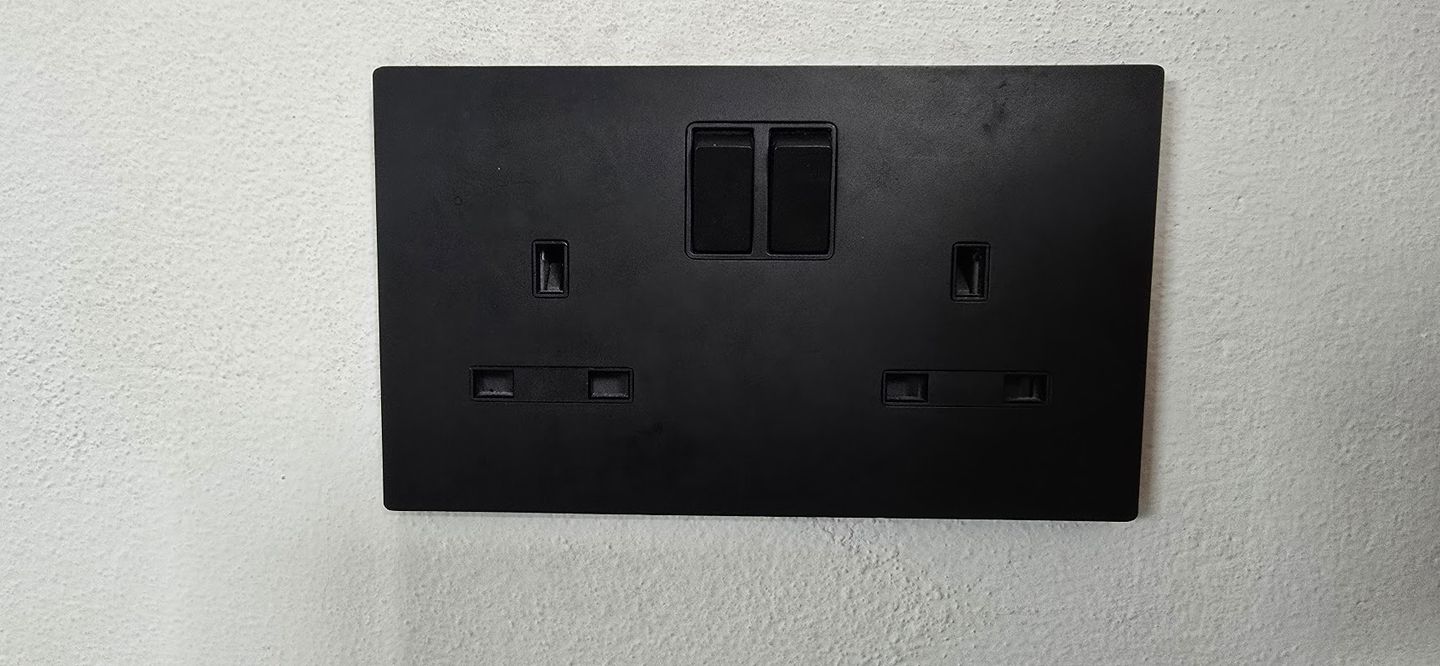
Cyprus uses type G sockets, the same ones as in the UK and Ireland. They’re defined by the British standard BS 1363: three flat pins arranged in a triangle, with the top and longest one being earth. The same standard applies across the whole country, including the north of the island.
Where does it come from? Cyprus was under British administration from 1878 to 1960, and the entire electrical network was built to British rules. After independence nobody saw the point of rewiring every house in the country. Joining the EU in 2004 didn’t change anything either, because the EU doesn’t impose a single plug type.
A Pole looking at one of these sockets is surprised by several things at once. The live and neutral holes are covered by a plastic shutter that only opens when the longer earth pin pushes it. Next to the holes there’s almost always a small switch, often with a red marker when it’s on. And every plug has a fuse inside, which I’ll come back to, because it’s the most important difference.
The shutters are good news for parents. Our kids have run all over the house since they were little and I never bought socket covers, because a child can’t push a hairpin or a key in there. You’ll find more about life here with kids in the post on whether Cyprus is a good place for families. The British organisation Electrical Safety First actually advises against plastic covers for BS 1363 sockets, because they can open the shutter and do more harm than good. The Cypriot EAC allows them as an alternative, but with shuttered sockets they aren’t needed.
⚡ What is the voltage in Cyprus - 230 V or 240 V?
Many guides will tell you the voltage in Cyprus is 240 V. That’s an old figure. The network used to be designed for 240/415 V, but as part of harmonisation with the rest of Europe the nominal voltage today is 230 V at 50 Hz, exactly the same as in Poland.
| Poland | Cyprus | |
|---|---|---|
| Nominal voltage | 230 V | 230 V (240 V in older sources) |
| Frequency | 50 Hz | 50 Hz |
| Socket type | E (with earth pin) | G (BS 1363) |
| Fuse in the plug | no | yes, usually 3 A or 13 A |
| Switch at the socket | rarely | almost always |
For your devices the difference between 230 and 240 V doesn’t matter. The European standard allows a 10% deviation either way, so from 207 to 253 V, and equipment designed for 230 V fits comfortably in that range. You don’t need a transformer or a voltage converter, just an adapter that changes the plug shape. A transformer is only useful for equipment from the US or Japan that runs on 110-120 V.
🧳 Which adapter should you buy for Cyprus?
My adapter from the corner shop had neither earth nor a fuse, and it stayed in the socket on a wing and a prayer. It was fine for a phone charger. I wouldn’t have used it for a kettle.
Polish plugs come in two kinds. The flat plug without earth (type C, the so-called Europlug) is for phone chargers, laptops, shavers. The thick round plug with earth (type E/F, Schuko) is for the kettle, iron, vacuum cleaner, hair dryer. For the second kind you need an adapter that is earthed and accepts both the pin of the Polish type E and the side contacts of the German Schuko.
When buying, I look at four things:
- a 13 A fuse in the adapter - decent Schuko-to-UK adapters have a BS 1362 fuse inside, just like an ordinary Cypriot plug
- a BS 1363-5 or BS 8546 marking - these standards cover conversion and travel adapters
- rated load - many cheap adapters are rated at 10 A, which is too little for a 2-3 kW kettle or heater
- a firm fit - a good adapter sits securely in the socket and doesn’t fall out under the weight of the cable
Prices are low. In Cypriot electronics shops a simple EU-to-UK adapter costs about 2-3 euros, branded adapters with a fuse and earth anything from a few euros to fifteen or so. You can buy them practically everywhere: electronics shops, Jumbo, bigger supermarkets, kiosks and at Larnaca or Paphos airport (the most expensive option). In Poland you’ll find them in any electronics store or online under “UK adapter” or “type G adapter”. Some hotel receptions lend adapters, and older holiday apartments sometimes have a single European socket, but don’t count on it and bring your own.
For a longer stay, instead of five adapters buy one power strip with a type G plug and Schuko sockets. You plug it into the wall once and plug all your Polish devices into it. Less plastic sticking out of the walls and fewer plugs falling out.
One thing never to do, although I’ve seen friends do it: don’t open the socket shutter with a screwdriver or a pen to force a Polish plug in. That’s a straight road to an electric shock or a short circuit.
If you’re moving for good, you have one more option: replacing the plug with a British one. You cut off the Polish plug, screw on a type G plug with the right fuse, and the device works as if you’d bought it locally. A BS 1363 plug on its own costs a few euros in an electrical supplies shop or a DIY store like Superhome Center. I did this with several things I brought from Poland. If you’re not confident with wiring, ask an electrician, it’s a few minutes’ work.
🔥 The fuse in the plug - the biggest difference
Every Cypriot plug has a small cylindrical cartridge fuse inside, to the BS 1362 standard. You’ll most often come across two kinds:
- 13 A, brown - for high-power appliances like a kettle, washing machine, heater or iron
- 3 A, red - for equipment under about 700 W, such as lamps, chargers, the TV, the router
Why all this? In the British system socket circuits can be protected at the consumer unit at up to 32 A (the so-called ring circuits), which is too much for a thin lamp cable. So the fuse in the plug protects the cable of that specific appliance: if the lamp cable shorts, the fuse in its plug blows before the thin wire starts to melt.
In practice this means that when a device suddenly stops working, check the fuse in the plug before you throw it away. In most plugs you can slide it out with a flat screwdriver in a few seconds. The Electricity Authority of Cyprus (EAC) reminds people in its safety advice never to fit a fuse with a higher rating than the previous one. You can buy spares in electrical shops and bigger supermarkets. I keep a few in the battery drawer.
And the switch next to the socket? It works as an extra double-pole switch. At first I kept forgetting to flip it and wondered why my phone wasn’t charging. Now I appreciate being able to cut power to the washing machine or the TV without pulling the plug.
🚿 Is there a socket in the bathroom in Cyprus?
Usually not. The electrician didn’t forget anything, this rule came from British regulations. The EAC explicitly advises against installing sockets, switches or electrical appliances in the bathroom, because water and steam increase the risk of electric shock. In the UK an ordinary socket in a bathroom has to be at least 3 metres from the bath or shower, which in a small bathroom is simply impossible.
What instead? In many homes, and almost always in hotels, you’ll find a small shaver socket. It has two holes, flat European plugs often fit it too, but it’s meant only for shavers and electric toothbrushes. It has very low power and a built-in isolating transformer. You can’t plug a hair dryer, straightener or curling iron into it.
So people dry their hair in the bedroom or at a socket in the hallway.
🏗️ Sockets when building a house in Cyprus - what to agree with the electrician
When we were building our house, I spent quite a lot of time with the electrician on the socket layout. You see those decisions every day afterwards, every time you vacuum or charge your phone.
First the formalities. In Cyprus an electrical installation can only be done by an electrician licensed by the Electrical and Mechanical Services Department. They submit the documents to the EAC, and before the house is first connected to the grid the EAC carries out an inspection of the installation. Only once it passes do you get the certificate (Certificate of Suitability) and power. Connecting without an inspection is an offence. The same applies to extensions or major changes to the installation. In our case the developer handled the formalities, but it’s good to know how it works, because without it you won’t sign an electricity supply contract either.
This is what I learned during the build:
- lots of double sockets, because older Cypriot houses often have too few and every room ends up full of extension leads
- sockets with built-in USB ports by the beds, in the kitchen and in the office, so nobody hunts for chargers; they cost more than ordinary ones, but we use them every day
- outdoor sockets on the terrace, by the barbecue and by the pool, weatherproof and protected by a 30 mA residual current device, which the EAC recommends for sockets you use in the garden
- a separate circuit for an electric car charger in the garage or under the carport, even if you drive a petrol car today; adding it later means chasing walls and a new cable from the consumer unit
- sockets behind the TV recessed into the wall and conduits under the plaster for cables, which I wrote more about when describing how we planned our new house around us
Big appliances don’t hang off ordinary sockets. Our induction hob and oven have their own circuits and are hard-wired through a separate switch, without a plug. The same goes for the water heater and the heat pump. In Cypriot homes you’ll often see a characteristic large switch with a red light next to the water heater, which people use to switch the immersion heater on by hand in winter. Every high-power appliance like that is something to discuss with the electrician at the design stage, because adding a new circuit later is hard without chasing walls.
Plan sockets around specific furniture. Mark on the plan where the bed, desk, TV and coffee machine will go. An electrician in Cyprus will do what you show him, but he won’t guess where you’ll put the sofa.
If you’re planning solar panels or air conditioning in every room, tell the electrician at the start. The consumer unit and cable sizes have to handle it. I broke down how much electricity really costs with the air conditioning on in the post on electricity prices in Cyprus.
🛒 What to pack and what to buy right after landing
In your suitcase from Poland:
- two or three decent Schuko-to-UK adapters with earth and a 13 A fuse
- one power strip with a type G plug and Schuko sockets for the desk or the bedside
- a simple adapter for the phone charger in your hand luggage, so you don’t repeat my first evening
There’s no point bringing small electronics, chargers and small appliances. In Cyprus you can buy them with a British plug and forget about adapters. Bigger equipment from Poland works without problems, because the voltage is the same. If you’re shipping it in parcels, as I did when I sent my things to Cyprus with Poczta Polska, buy a few British plugs locally and swap them onto the devices you use every day.
Locally, in the first week:
- a few BS 1363 plugs to fit on the kettle, lamps and equipment from Poland
- spare 3 A and 13 A fuses
- when viewing a rental, look under the furniture and check how many sockets there are, whether they’re yellowed or loose and whether the switches work
BS 1362 fuses usually come in small packs of a few, and the kettle plug always gets a 13 A one.