Konstantina:
Stone Oven in Cyprus - Fourno and Family Traditions
My aunt and uncle live in the same village as us. In their backyard, next to the fig tree, there’s a stone oven - fourno - that dates back to their parents’ time. The bricks are cracked from decades of heat, the opening is blackened with soot, and yet the oven works perfectly. When my uncle says “we’re lighting the fourno,” the whole family knows that hours of cooking together, waiting, and eating are ahead - and nobody minds one bit.
🔥 What is a fourno and how does it work
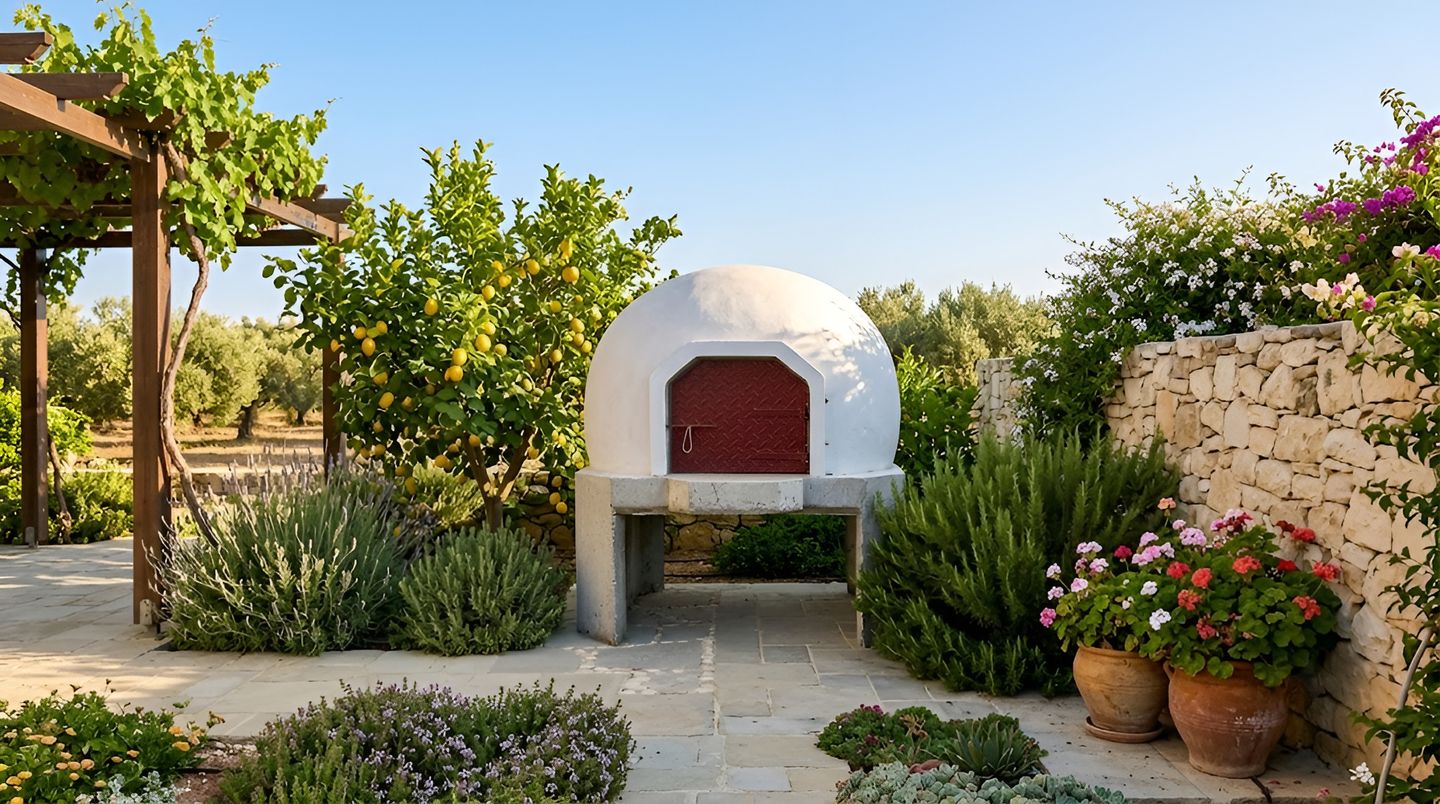
Fourno is a traditional wood-fired oven, built from stone or brick, with a domed chamber inside. You’ll find them in the backyards of village homes all across Cyprus - sometimes freestanding, sometimes built into a wall.
The principle is simple, but it requires patience:
- you light a fire inside the chamber (usually with olive or carob wood)
- you wait 2-3 hours until the stone heats up evenly
- you rake out the embers and ash
- you put the food in and seal the opening
The temperature inside drops slowly and evenly - perfect conditions for long baking. Meat comes out so tender it falls apart on the fork. Bread gets a thick, crispy crust that no modern oven can replicate.
But you need to get up early. At our family’s place, the fire starts at five or six in the morning - so that by ten the chamber is ready for food.
🍖 What we bake in the stone oven
Kleftiko - the king of the fourno
Kleftiko is lamb slow-roasted in a sealed dish until the meat starts falling off the bone on its own. In a stone oven, where heat surrounds it from all sides for several hours, kleftiko reaches a texture you simply cannot replicate in a kitchen. This is a dish that requires a fourno - it’s just not the same from a regular oven.
Village bread
Traditional Cypriot bread from the fourno has a thick, cracked crust and a moist, dense interior. The smell of fresh bread from the stone oven is probably the strongest childhood memory I have. My grandmother baked it on Saturdays - enough for the whole week.
Flaounes at Easter
This is the tradition of all traditions. Flaounes are Cypriot Easter pastries with a cheese filling, baked in the fourno a few days before Easter. Families wake up before dawn to get the oven fired up in time.
Trays go into the oven one after another, the yard smells of cheese and yeast, children run around - this is Easter in Cyprus. You can make flaounes in a modern oven (and we do), but the taste and atmosphere of the fourno is a completely different level.
Large trays for family gatherings
Cypriot families are big - gatherings of 20-30 people are the norm, not the exception. The fourno is perfect for this: you slide in several large trays at once (potatoes, meat, vegetables) and feed everyone in a single load.
☕ Fourno isn’t just about cooking - it’s a gathering point
When the fourno is heating up, nobody stays inside. Everyone comes out to the yard. My uncle tends the fire, my aunt prepares the trays, the rest of the family drinks coffee, kids play. Those 2-3 hours of waiting aren’t “wasted time” - it’s time together.
This is something you can’t transfer to a modern kitchen. An electric oven heats up in 10 minutes and doesn’t require anyone’s presence. The fourno demands attention, presence, cooperation - and that’s why it naturally brings people together in one place.
My mum says that as a child she wasn’t waiting for the food from the fourno - she was waiting for that gathering. The food was the reward, but the real value was the shared time.
🏘️ Why the fourno has survived
Modern kitchens have everything - convection ovens, microwaves, air fryers. Yet stone ovens stand in backyards and nobody tears them down. Why?
- the taste is impossible to fake - long, even baking in a sealed chamber produces a result unlike anything else
- capacity - for large family gatherings, a home oven isn’t enough
- ritual - lighting the fourno is an event, not a chore
- heritage - the oven has stood for generations, it carries sentimental value
- simple to build - stone, brick, clay. No electricity, gas, or servicing needed
Even the younger generation, who use modern appliances daily, comes back to the fourno for holidays and family gatherings. It’s not nostalgia - it’s simply better food in better company.
🧱 A fourno with a new house - does it make sense?
We considered building an oven at our house, but we chose a different path - we’re planning an electric oven instead. A traditional wood-fired fourno sounds beautiful, but in practice the smoke and soot can ruin PVC fencing and garden furniture. With the layout of our yard, there was nowhere to place it far enough from the fence.
An electric oven won’t give you the same smoky aroma, but on the other hand:
- it doesn’t dirty the surroundings
- it doesn’t require waking up at five in the morning
- you don’t need a wood supply
- you can place it closer to the house
If you have a large yard and distance from neighbours - a traditional wood-fired fourno is obviously the better experience. But you need to be realistic about your space.
🌅 The scent that defines home
For me, the stone oven is the smell of Saturday mornings at my aunt’s place. Olive wood smoke, heat radiating from the chamber, my aunt’s voice saying “a little longer, don’t open it.” That is home in its purest form.
There are traditions that die because they lose their purpose (like outdoor showers next to the fields). But the fourno isn’t dying - because the food from it is objectively better, and the time spent around it is objectively more enjoyable. As long as Cypriot mentality puts family and shared meals first, stone ovens will stand in backyards.