Łukasz:
Outdoor Shower in Cyprus - Tradition and Everyday Use
A few years ago we were renting a house in Avgorou. First day, I’m looking around the yard and I see it - a shower mounted on the side wall of the house. A pipe coming out of the wall, a shower head, a small tiled section of floor with a drain. No enclosure, no curtain. I thought: “what kind of makeshift setup is this?” It took a Cypriot neighbour to explain that it’s a completely normal thing - and suddenly everything clicked.
🌾 Where did outdoor showers in Cyprus come from?
Until recently, Cyprus was an agricultural country. People worked in the fields with olives, potatoes, animals. They came home covered in dust, mud, and sweat. Walking into the house in that state? Not an option.
The outdoor shower was the first stop after coming back from the field. You washed off, changed clothes, and only then entered the house. It wasn’t about luxury or aesthetics - it was about cleanliness and respect for shared living space.
Kids after a whole day outside? Same thing. A quick shower outdoors and then inside for dinner. Simple and effective.
☀️ A climate that forces life outdoors
In Poland this is hard to understand, because we spend most of the year indoors. In Cyprus it’s the opposite - from April to November you practically live outside. Cooking on the terrace, eating in the garden, evenings by the grill.
At these temperatures (regularly 35-40°C in summer) a quick cool-down under the shower isn’t a whim. It’s a necessity. Especially when:
- you come back from the garden after watering
- you’ve been grilling in full sun
- the kids have been playing outside since morning
- you simply want to refresh without going into the air-conditioned house (because the temperature difference can catch you off guard)
🏊 Today the outdoor shower is standard by the pool
Traditional agricultural showers disappeared along with life in the fields. But the format survived - just in a new role. If you have a pool at your house, an outdoor shower is mandatory.
We use ours daily from May to October:
- before getting in the pool - to wash off sunscreen and sweat (this extends the life of the water and chemicals)
- after getting out - to rinse chlorine off skin and hair
- for guests - so they don’t have to walk wet through the living room to reach the bathroom
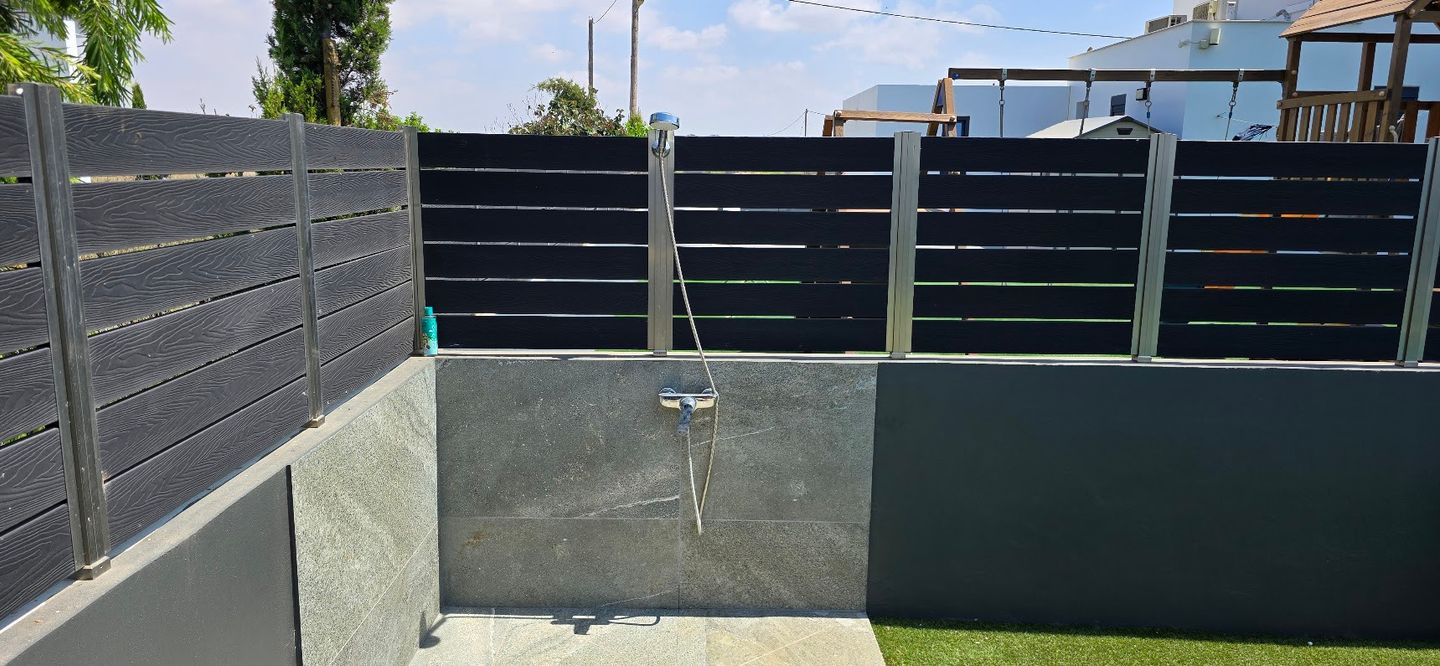
When we built our house, we ran pipes to the outside in the spot where we planned to eventually put a pool. A few years later, when the pool was actually built, all we had to do was connect a shower head to the ready-made plumbing. The whole installation took the plumber two hours, and the shower itself cost about 150 euros.
🔧 What to know about installation
If you’re building a house or planning a renovation, an outdoor shower is a small detail, but worth planning ahead. A few practical notes:
- Hot water - unnecessary in summer (water in sun-exposed pipes reaches 30-40°C), but in winter you’ll appreciate a connection to a boiler or solar heater
- Drainage - don’t direct it onto the lawn, chlorine kills vegetation. Better to route it to a drain grate
- Surface - anti-slip tiles or natural stone. Smooth tiles + wet feet = accident
- Privacy - a pergola with climbing plants or a bamboo screen is enough. No need to build a walled enclosure
- Materials - stainless steel for the shower head, because cheaper plastics crumble from UV exposure in 2-3 seasons
🏊 How it works after the beach
A separate matter - the outdoor shower after coming back from the beach. Most Cypriot beaches have public showers, so you rinse off on the spot. But sand and salt have a way of sticking around. In the car, on your skin, in your hair.
We have a routine: we come back from the beach, the kids go straight to the outdoor shower before entering the house, I rinse off my feet and flip-flops. Nobody brings sand onto the couch, nobody blocks the bathroom. Two kids washed in three minutes, no queue and no wet floor in the hallway.
Without an outdoor shower we’d either have to stand there with a garden hose (uncomfortable), or let the entire beach into the house. The choice is simple.
🏡 Outdoor shower and property value
I’m not exaggerating when I say that when choosing a plot and designing a house in Cyprus, an outdoor shower by the pool is a standard whose absence surprises people. It’s like a house without air conditioning - technically possible, but nobody does it.
Real estate agents list it in ads alongside the pool and BBQ as part of outdoor living - because that’s exactly the philosophy. In Cyprus a home isn’t just four walls - it’s the entire property, with balconies, terraces, and yes, an open-air shower.
If you ever sell your home, an outdoor shower with proper finishing (natural stone, quality fixtures) adds to the overall impression of a “complete house.” It’s not a separate line item in the valuation, but a piece of the puzzle that tells a buyer: someone here thought about outdoor living.
🧠 A Pole’s perspective - from oddity to daily habit
I’ll be honest - in Poland I wouldn’t have understood this. An outdoor shower brings to mind camping or a makeshift setup on a construction site. But after a few years in Cyprus I use mine more often than the one in the bathroom (at least in summer).
There’s something pleasant about showering under the open sky, with a view of the garden, in the warm evening air. My wife says it’s the typical Cypriot approach - don’t overcomplicate things, use what you have, live outdoors.
And she’s right. A simple outdoor shower gives me more joy than many a “luxury” installation inside the house.
If you’re building or buying a house in Cyprus and you have a pool or even just a garden - plan an outdoor shower from the start. It’s a minor item in the budget, but something you’ll use every day for half the year. And when the August heat hits 42°C and all you want is twenty seconds of cold water on the back of your neck - you’ll appreciate it more than anything else in the house.